

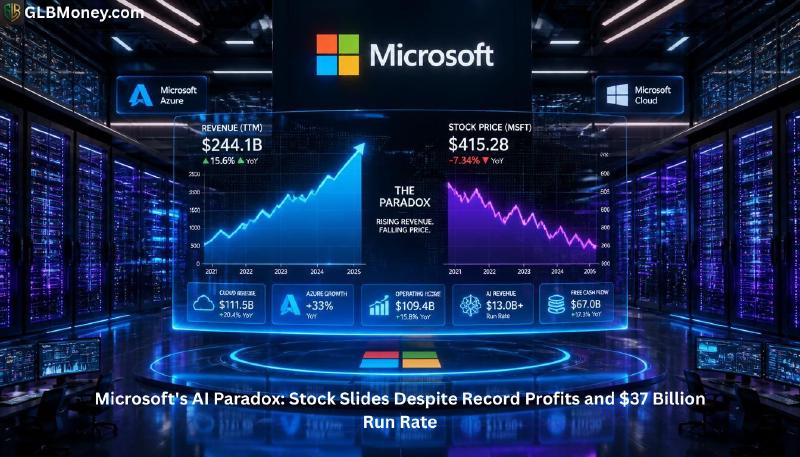
Microsoft Corporation (MSFT) shares trade consistently lower during the Friday trading session. Even after the company delivers blockbuster quarterly results, the market’s response remains heavily subdued and muted.
However, this quiet reaction makes the stock appear even more attractive in the eyes of analysts. In early trading, Microsoft shares slide about 1.2% to hit the $419 mark, following a steep 1.8% decline recorded just a day prior.
This post-earnings lull leaves everyday investors a bit puzzled, but astute market participants view it through a completely different lens. This dip comes at a time when Microsoft once again shatters Wall Street’s expectations.
The tech giant maintains its stellar streak of quarterly outperformance. However, the market currently seems disinclined to bid the stock up based solely on headline numbers.
According to the latest report, Microsoft clocks a massive revenue of $82.89 billion and a net income of $31.78 billion. It comfortably beats consensus estimates on both revenue and operating income fronts.
Given the stock’s massive rally over the past two years and its colossal market cap exceeding $3.11 trillion, investors are understandably turning a bit cautious about chasing new buys.
The most fascinating play of this entire earnings report is hidden within its AI business. It transitions from future hype and promises into the company’s primary growth engine.
Microsoft’s pure AI business now reaches an annualized AI Revenue Run Rate of $37 billion, marking an incredible and unprecedented 123% surge year-over-year. This data loudly highlights that Microsoft emerges as the clear leader in translating the global AI revolution into concrete, hard cash.
This financial muscle directly boosts the company’s bottom line, with Microsoft reporting a diluted EPS of $4.27, beating expectations by a wide margin of 5.25%.
Stock Performance & Overview #
| Symbol | Company Name | Price | Change | % Change | Prev Close |
|---|---|---|---|---|---|
| MSFT | Microsoft Corp | $418.57 | -0.52 | -0.12% | $419.09 |
| NVDA | NVIDIA Corp | $215.33 | -4.18 | -1.90% | $219.51 |
| AAPL | Apple Inc | $308.82 | +3.83 | +1.26% | $304.99 |
| GOOGL | Alphabet Inc Class A | $382.97 | -4.69 | -1.21% | $387.66 |
But this muted market reaction is the clearest proof that smart money is no longer getting emotional over headline figures. At first glance, these spectacular numbers easily convince retail investors that Microsoft’s empire is completely invincible.
Conversely, the current price action clearly indicates that the company’s highly aggressive future growth expectations are already largely baked into the stock price. Institutional investors meticulously rebalance their positions right now.
They know very well that this magical AI revenue doesn’t come free; it carries a massive underlying cost and heavy capital expenditure. This explains the strange sluggishness and profit-taking weighing down the stock despite record profits.
History shows that whenever a mega-cap stock consistently touches all-time highs, some profit-booking or technical fatigue after a major earnings event is entirely healthy and expected. Instead of viewing this muted reaction as a red flag, it should be seen as a healthy consolidation phase that gives large institutional players a window to accumulate shares at lower levels.
The Financial Math of Massive Capex Spending and Azure Outperformance #
Following the post-earnings pullback, the biggest debate across global markets centers around Microsoft’s massive capital expenditure (Capex). The company clearly indicates in its management commentary that it plans to deploy a staggering $190 billion Capex toward infrastructure and AI capacity expansion.
This figure is so massive that it eclipses the annual budgets of several developed nations. Seeing this number, short-term investors and retail traders panic, fearing this aggressive spending might completely erode the company’s operating margins and profitability in the coming quarters.
However, this spending isn’t a financial cash drain; it is an absolute necessity driven by skyrocketing demand. To understand this, one simply needs to look at the performance of the company’s cloud division.
In this latest quarter, Azure Cloud posts a blockbuster 40% growth, easily outpacing Wall Street’s consensus estimate of 37.9%. This data proves that Microsoft’s historic spending isn’t a blind gamble—it is a direct response to the massive demand for AI computing power.
In today’s market, as demand for Nvidia GPUs continues to surge, Microsoft must aggressively scale and build out new data centers to capture that demand and secure its future revenue pipeline. A close look at the financial metrics of this segment reveals truly astonishing efficiency and profit-generation capabilities.
During the quarter, the company’s Cost of Revenue stands at $26.83 billion, primarily driven by large-scale server and infrastructure maintenance. Despite these heavy operating costs, Microsoft maintains an incredible net profit margin of 38.34%.
Sustaining such high margins while operating at this massive scale is nothing short of a miracle in the global tech industry, underscoring the company’s robust pricing power. This continuous Azure outperformance proves that its infrastructure bet is well-protected and serves as the ultimate seed for future earnings growth.
Top Tech Giants: Valuation & Profit Margins (May 2026) #
| Symbols | Price | Change (% / Day) |
|---|---|---|
| AAPL Apple Inc | $308.82 | +1.26% |
| AMZN Amazon.com Inc | $266.32 | -0.80% |
| GOOGL Alphabet Inc Class A | $382.97 | -1.21% |
| MSFT Microsoft Corp | $418.57 | -0.12% |
Microsoft Financial Health Card & Earnings Data #
| Financial Metric | Actual Data | Expectation | Result |
|---|---|---|---|
| Quarterly Revenue | $82.89 Billion | $81.43 Billion | Beat (+1.79%) |
| Earnings Per Share (EPS) | $4.27 | $4.06 | Beat (+5.25%) |
| Azure Cloud Growth | 40% | 37.9% | Outperformed |
| AI Run Rate (Annualized) | $37 Billion+ | — | 123% YoY Increase |
Copilot’s Software Ecosystem and the Enterprise Lock-In Moat #
What brings the ultimate stability to Microsoft’s global dominance is its enterprise software business, which is now deeply integrated with Copilot AI. According to official company data, Microsoft 365 Copilot crosses 20 million paid users worldwide, representing a stellar 250% year-over-year growth.
This isn’t a temporary spike; it is concrete proof that global corporations and large enterprises become deeply reliant on Microsoft’s AI tools for their daily workflows. This is a textbook example of Enterprise Lock-in.
Once a major corporation integrates its sensitive data, emails, and entire operational workflow into Microsoft’s AI ecosystem, migrating to a competitor becomes nearly impossible. Shifting to another platform is incredibly complex, disruptive, and cost-prohibitive.
Behind these massive numbers lies a powerful financial metric known as ARPU (Average Revenue Per User). Whenever an enterprise customer upgrades its traditional Office subscription to include the new Copilot AI, Microsoft effectively doubles or triples the revenue generated from that single user seat.
This is the real economic moat that safeguards Microsoft over the long term. No matter how intense the chip wars among hardware manufacturers get in the future, displacing the software infrastructure that serves as the backbone of global offices is a monumental task.
Through Copilot, Microsoft engineers a powerful ecosystem for its clients, fully justifying its massive $8.75 billion selling and administrative expenses into highly profitable returns.
Therefore, this growing army of paid seats isn’t just a headline metric; it is Microsoft’s most secure asset for future cash flows. Furthermore, the company reduces its reliance on OpenAI by actively developing internal custom AI chips, like ‘Maia’, which optimize its infrastructure costs going forward.
Nvidia Comparison and Microsoft’s Valuation Play at Current Levels #
Valuation emerges as the most compelling part of the Microsoft story right now. The recent pullback makes this blue-chip stock fundamentally cheap. According to FactSet data, this price correction brings Microsoft’s forward Price-to-Earnings (P/E) ratio down to just 24.93 P/E.
This multiple sits significantly below Microsoft’s five-year historical average. It presents a classic market disconnect: the company’s earnings consistently climb, but short-term market anxiety drags the stock price lower.
When compared to AI sector darling Nvidia—whose comprehensive operational and financial structure we analyzed in our previous Nvidia Stock Analysis—Microsoft’s current valuation looks highly attractive and offers a solid margin of safety. While hardware leaders trade at highly premium forward multiples, Microsoft at its current levels presents a classic enterprise software value play.
Analysts argue that Microsoft’s current stock price fails to reflect its long-term growth profile and its dominant position in AI infrastructure. Picking up MSFT at a 24.93 P/E forward multiple gives long-term tech investors a highly compelling entry point.
Microsoft also aggressively expands its footprint beyond corporate clients into Sovereign AI initiatives. In today’s geopolitical landscape, governments worldwide want their own secure, localized AI models and maintain stringent data privacy mandates.
Microsoft’s integrated hardware-and-software ecosystem makes it the premier choice for these governments and large global enterprises. Additionally, a robust EPS of $16.79 and a steady 0.87% dividend yield provide a solid valuation floor for the stock.
From a technical perspective, the stock corrects by nearly 24% from its 52-week high of $555.45. Such steep pullbacks in a blue-chip tech titan are rare, offering a prime window for long-term investors.
The market seems overly emotional and fearful regarding the company’s near-term spending. Investors overlook the reality that Microsoft’s combined cloud and cybersecurity ecosystem remains non-discretionary corporate spend, even during economic slowdowns. Enterprise cybersecurity is a vertical no corporation can afford to cut.
With Microsoft’s commercial cloud business now crossing the $54 billion milestone—growing at a robust 29% annually—the company generates highly resilient cash flows to weather market volatility. Mistaking the current valuation for a value trap is a major oversight; it represents a hidden gold mine for long-term wealth compounding.
Insider Transactions and Trading Signals from US Policymakers #
Amid Microsoft’s stellar and record-breaking financial run, recent corporate filings reveal some insider activity that raises eyebrows among retail investors. According to regulatory filings, a few top executives recently unload notable blocks of shares from their portfolios.
When news of insider selling or discretionary sales hits the headlines, retail investors often get anxious, wondering why company insiders sell if the future looks so bright.
However, a technical and practical breakdown of this insider selling reveals a standard corporate routine that every investor should understand. Executive compensation at mega-cap corporations is heavily weighted toward stock options and Restricted Stock Units (RSUs) rather than cash.
These executives routinely execute pre-scheduled sales under specific regulatory frameworks to cover personal tax liabilities or diversify their personal wealth across different asset classes. Therefore, viewing these routine insider sales as a structural flaw in the business model or an indicator of trouble ahead is an inaccurate and reactionary assessment.
Conversely, looking at the recent data coming out of Washington reveals a highly positive sentiment that should reassure everyday investors.
Recent trading disclosures show that influential US congressional lawmakers actively build sizable new positions in Microsoft shares.
When policymakers and lawmakers deploy their personal capital into a stock, it sends a highly reassuring signal to the market. It clearly suggests that the company faces no imminent antitrust or regulatory headwinds that could derail its operations. With policymakers backing this tech giant, the company’s regulatory and legal defensive perimeter appears exceptionally secure.
Financial Action Plan for Long-Term Investors #
After a comprehensive analysis of all financial metrics, historical valuation multiples, and strong technical support zones, the strategy for investors becomes crystal clear.
If you already hold this stock from lower levels, there is absolutely no reason to panic over this short-term correction or daily market noise. This $190 billion Capex spending is an essential investment that strengthens Microsoft’s AI moat, keeping competition at bay for years to come. Holding your position quietly remains the most prudent and profitable move right now.
For new buyers looking to deploy fresh capital or scale into this dip, the current levels look highly favorable.
On the technical charts, the zone between $416-$420 support zone acts as a historical, ironclad support level where large institutional buyers typically accumulate shares.
According to financial analysis from glbmoney.com, rather than deploying all capital at once, new investors should take advantage of this opportunity by scaling in through a systematic stock-SIP or a staggered buying approach around this support zone. The risk-reward ratio currently stands heavily skewed in favor of buyers.
However, disciplined investors must remain mindful of potential risk factors that require ongoing monitoring.
The biggest risk facing Microsoft stems from mounting global regulatory and antitrust pressures, as both US and EU regulatory bodies continue to scrutinize the market power of Big Tech giants. Navigating this with a balanced, diversified portfolio strategy while remaining invested in Microsoft is the best approach to secure long-term capital appreciation.
Important Frequently Asked Questions (FAQs) #
-
Is Microsoft stock safe for long-term investment?
Yes, Microsoft features an incredibly resilient business model. It boasts a massive cloud engine exceeding $54 billion and a highly sticky cybersecurity vertical. Its 38.34% net profit margin highlights exceptional corporate pricing power. The $416-$420 support zone serves as a historically safe entry point for long-term investors. -
How will the massive $190 billion Capex spending affect Microsoft’s profitability?
In the short term, this heavy capital expenditure may exert temporary pressure on free cash flows, but it should be viewed as a growth investment rather than an expense. Microsoft’s Azure cloud delivers a staggering 40% growth this quarter. Building out this infrastructure is absolutely critical to secure Nvidia GPUs and capture global AI demand, effectively guaranteeing future revenue streams. -
What does Microsoft’s forward P/E ratio indicate?
Following the recent pullback, Microsoft’s forward P/E ratio compresses to 24.93 P/E. Compared to other AI sector leaders like Nvidia, this valuation is highly attractive. This lower P/E ratio provides long-term investors with a solid margin of safety and turns the stock into a classic value play. -
What impact will the growing number of paid Copilot AI users have on the company?
Copilot surpasses 20 million paid users, growing at a phenomenal 250% year-over-year rate. This establishes a powerful corporate lock-in ecosystem. Once an enterprise integrates its data into this architecture, switching platforms becomes cost-prohibitive, guaranteeing highly recurring and sticky revenue for Microsoft.
Sources & Core References #
- Primary Source Analysis: Nvidia Stock Analysis & Structural Breakdown
- Official Corporate Release: Microsoft Investor Relations: Q3 Fiscal 2026 Financial Results
- Market Expenditure Data: CNBC Report on Microsoft’s $190 Billion AI Infrastructure Expansion
- Financial Consensus Tracking: FactSet Financial Data & Forward Valuation Metrics